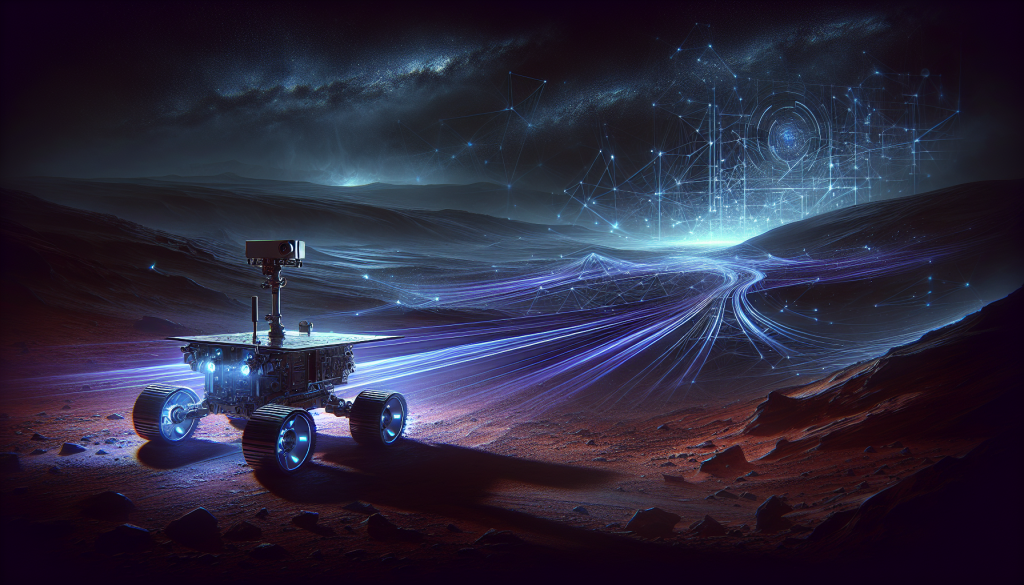
In a historic achievement that marks a new era for space exploration, NASA Perseverance rover has made history by driving across Mars using routes planned by artificial intelligence instead of human operators. This groundbreaking development means that for the first time ever, a vehicle on another planet is making its own navigation decisions using advanced AI vision models, specifically leveraging Claude vision-language technology to analyze terrain and plan safe routes. This breakthrough could fundamentally transform how we explore distant worlds, potentially enabling faster scientific discoveries and paving the way for more autonomous robotic missions across our solar system. As AI systems become increasingly capable of operating independently in extreme environments, we may be witnessing the beginning of an age where machines can explore places too dangerous or too distant for immediate human oversight, fundamentally changing our relationship with space exploration and our ability to understand the universe around us.
How AI is Driving on Mars
The technology behind this historic achievement involves sophisticated artificial intelligence that can process and understand visual information much like a human would, but without needing constant instructions from Earth. The system uses vision-language models to analyze orbital imagery and terrain data and autonomously generate safe waypoints. This is revolutionary because traditional Mars rover operations require human mission planners on Earth to study images, plot courses, and send commands to the rover – a process that can take hours or even days due to the communication delay between Earth and Mars. With AI doing this planning work directly on or near the rover, the exploration process becomes dramatically more efficient. The artificial intelligence examines the Martian landscape, identifies potential hazards like large rocks or steep slopes, evaluates the scientific value of different areas, and then creates a route that balances safety with research objectives. This represents a massive leap forward from rovers that simply execute pre-programmed instructions to ones that can think and adapt on their own.
Why This Matters for Future Space Exploration
The implications of AI-planned Mars drives extend far beyond just making one rover more efficient. This technology fundamentally changes what is possible in space exploration. When humans send commands to Mars, there is a significant time delay – sometimes up to 24 minutes for a signal to travel from Earth to Mars and back. This means that if a rover encounters an unexpected obstacle or opportunity, it must either wait for human instructions or follow very basic pre-programmed responses. With AI navigation, the rover can make sophisticated decisions in real-time, responding immediately to what it discovers. This could mean the difference between capturing a fleeting scientific observation or missing it entirely. Moreover, as humanity plans missions to even more distant locations like the moons of Jupiter or Saturn, where communication delays can be hours long, having truly autonomous AI systems will not be just convenient but absolutely essential. The technology being tested on Mars today is laying the groundwork for exploring worlds that humans may not visit in person for decades or even centuries.
The Technology Behind Autonomous Space AI
What makes this AI system particularly impressive is its ability to understand complex visual information and make judgments about what it sees. Unlike simple obstacle-avoidance systems that might just detect rocks and steer around them, vision-language models can comprehend the broader context of the terrain. They can recognize geological features that might be scientifically interesting, assess the stability of different surfaces, and even adapt their route planning based on the mission priorities and current conditions of the rover. The system essentially brings together multiple types of intelligence – visual processing, spatial reasoning, risk assessment, and goal-oriented planning – all working together to navigate an alien environment millions of miles from Earth. This represents a convergence of several AI technologies including computer vision, natural language processing, and autonomous decision-making systems. The fact that these systems can operate reliably in the harsh Martian environment, with its extreme temperatures, dust storms, and radiation, demonstrates just how robust and capable modern AI technology has become.
What This Means for Life on Earth
While this breakthrough is happening on Mars, the technology has profound implications for autonomous systems here on Earth. The same AI capabilities that allow a rover to navigate the red planet could be applied to autonomous vehicles navigating difficult terrain on our own world, from self-driving cars handling unexpected road conditions to rescue robots operating in disaster zones where human controllers cannot maintain constant communication. The ability of AI to make safe, intelligent decisions without human oversight could revolutionize industries from transportation to agriculture to emergency response. If an AI can be trusted to drive a multi-million dollar scientific instrument across an alien planet, the confidence in deploying similar systems for Earth-based applications increases significantly. However, this also raises important questions about the extent to which we should allow AI systems to make decisions without human approval, especially in situations where safety is paramount. The balance between AI autonomy and human oversight will be one of the defining challenges of the coming decades, and the lessons learned from Mars exploration will help inform those decisions.
The Future of AI in Space
This successful demonstration of AI-planned drives on Mars is likely just the beginning of a much larger transformation in how we explore space. Future missions may feature AI systems that can not only navigate but also decide what scientific experiments to conduct, when to collect samples, and how to respond to discoveries. Some scientists envision swarms of small AI-powered robots exploring planetary surfaces together, communicating with each other and coordinating their activities to cover more ground and make more discoveries than any single rover could achieve. As AI technology continues to advance, we may eventually see missions to distant worlds that operate for years with minimal human intervention, following high-level goals but making all the detailed decisions themselves. This could dramatically reduce the cost of space exploration while increasing the pace of discovery, allowing humanity to explore more destinations and answer more scientific questions than ever before possible. The partnership between human scientists and artificial intelligence may prove to be the key that finally unlocks the mysteries of our solar system and beyond, combining human creativity and curiosity with machine precision and tireless operation to achieve what neither could accomplish alone.