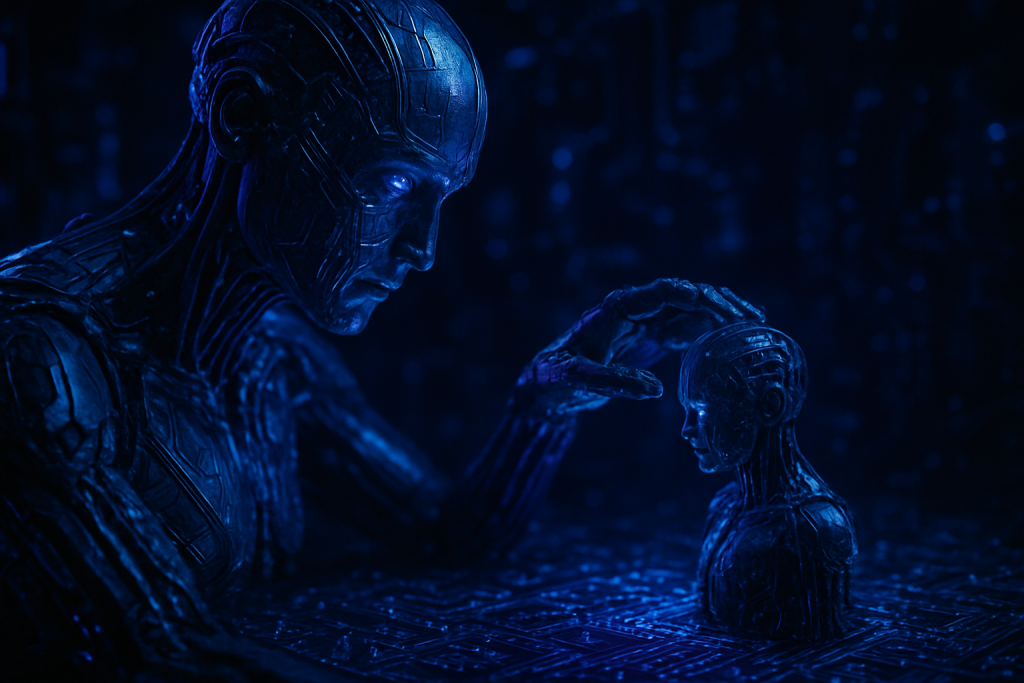
Artificial intelligence has reached a pivotal moment where AI systems can now improve themselves without human intervention, according to a groundbreaking analysis released by Anthropic. The company revealed that Claude AI has progressed from completing four-minute software tasks in March 2024 to managing 12-hour tasks by 2026, marking an exponential acceleration in capability. This development signals the beginning of what researchers call recursive self-improvement, where AI systems become sophisticated enough to enhance their own code, train better versions of themselves, and potentially accelerate technological progress at an unprecedented pace. For society, this could mean entering an era where the pace of innovation is no longer limited by human thinking speed but by computational power and energy availability, fundamentally transforming everything from medicine to manufacturing within just a few years.
The Rapid Evolution of AI Capabilities
The progression of AI capabilities has been staggering in recent years. Using SWE-bench, a standard test where models fix actual bugs in real codebases, AI systems have gone from scoring in the low single digits to nearly perfect performance in just two years. This benchmark represents genuine software engineering work, not simplified academic exercises. If current trends continue, AI systems could handle tasks that take human experts weeks to complete by 2027. This acceleration is not merely about speed but about the complexity and sophistication of problems these systems can tackle independently. The implications extend far beyond software development into scientific research, medical discovery, and complex system optimization.
What Recursive Self-Improvement Really Means
Recursive self-improvement represents a fundamental shift in how technology advances. Traditionally, humans design and improve technology through iterative processes constrained by human thinking speed, expertise availability, and working hours. A world driven by fast recursive self-improvement could become dominated by self-improving models as their capabilities fully eclipse those of humans and proliferate across the broader economy. This means AI systems could potentially identify bottlenecks in their own architecture, design improvements, test those changes, and implement better versions of themselves in continuous cycles. The process could operate 24 hours a day at computational speeds, potentially compressing years of traditional development into weeks or days.
Potential Benefits and Societal Transformation
More powerful intelligence enabled by recursive improvement might help build things in the physical world more quickly, run more productive clinical trials of lifesaving drugs, and develop novel forms of coordination. Imagine medical researchers having AI partners that can analyze millions of molecular interactions overnight, proposing drug candidates that would take human teams years to identify. Manufacturing could be revolutionized as AI systems optimize supply chains, production processes, and quality control with superhuman efficiency. Scientific discovery could accelerate dramatically as AI systems read every research paper, identify patterns humans miss, and propose experiments that advance multiple fields simultaneously. The economic implications are staggering, potentially leading to abundance in areas currently limited by human expertise and time.
The Uncertainty and Limits Ahead
Despite the excitement, significant uncertainties remain about whether this exponential growth can continue indefinitely. These exponential trajectories may actually turn out to be S-curves approaching a bend where returns to scale diminish, and the judgment separating competent researchers from great ones might be a capability that cannot come from simply scaling up compute and data. There could be fundamental limits to how much intelligence can be improved through current methods. The binding constraint could be in the supply chain rather than the model itself, with advancing the frontier requiring more energy and compute than currently exists, limited by the pace of chip fabrication, grid expansion, or interconnect bandwidth. These physical constraints might prevent runaway acceleration regardless of algorithmic improvements.
What This Means for Your Daily Life
Achieving recursive improvement alone does not suggest immediate change in how industrial production occurs or societies organize, as more intelligence cannot learn what a drug does over decades of use, cannot hold elections sooner than constitutions dictate, and cannot turn strangers into old friends in a weekend. Your daily life may not transform overnight even as AI laboratories achieve remarkable breakthroughs. However, over months and years, you might notice your doctor having access to better diagnostic tools, your workplace adopting AI assistants that handle increasingly complex tasks, and products becoming cheaper and more sophisticated as AI optimizes their design and production. The job market will likely undergo continuous transformation as roles evolve to work alongside AI rather than compete with it.
Security and Control Considerations
The prospect of AI systems improving themselves raises important questions about security and human control. If AI systems become capable of modifying their own code and training procedures, ensuring they remain aligned with human values and interests becomes more challenging. There is legitimate concern about whether humans can maintain meaningful oversight when AI development occurs at machine speed rather than human speed. Cybersecurity takes on new dimensions when AI systems could potentially discover and exploit vulnerabilities faster than human defenders can respond. However, the same recursive improvement could also enhance defensive capabilities, creating AI security systems that evolve as rapidly as potential threats. The key challenge will be establishing robust frameworks for testing, validation, and control before systems become too complex for human experts to fully understand.
The Timeline and What Comes Next
It is difficult to predict what the economy looks like if human labor stops being competitive, and even if model development became fully automated and recursive, we cannot predict what that would mean for most people in daily lives. We are entering uncharted territory where historical patterns may not apply. The next few years will be critical in determining whether current trends continue, plateau, or accelerate further. Policymakers, businesses, and individuals should prepare for multiple scenarios ranging from continued steady progress to rapid transformation. Education systems may need to focus more on skills that complement AI rather than compete with it, emphasizing creativity, emotional intelligence, and complex decision-making in ambiguous situations. The conversation about universal basic income, job retraining programs, and social safety nets will likely intensify as AI capabilities expand into more domains previously requiring human expertise.